Sunday, 1 March 2026

In memory of Ali Hosseini Khamenei


In the last two years, humanity has not just lost leaders—we have lost two fathers, two shields, two stars that guided us through the darkest nights. Sayed Hassan Nasrallah and Sayed Ali Khamenei were taken from us, not by time, but by the hands of those who cannot bear the light.

The West tried to convince you they were terrorists. But let me ask you, —Did they bomb children and call it self  defense? Did they imprison an entire nation into starvation and call it diplomacy? Have they raped the earth and the soul of humanity for power? No.

 These men were not terrorists. They were the last line of defense against the global network of predators—the Epstein class, the Zionist war criminals, the elite who feast on the blood of the innocent while wearing masks of civility.

They called it the "Axis of Evil." We knew it as the Axis of Hope.

The propaganda machine never stopped. It painted them as villains because they stood in the way of world domination. But truth has a way of rising from the grave. Sayed Ali Khamenei was not just a political figure—he was a spiritual mountain. A man of God in the truest sense. Imagine if someone from another faith assassinated the Pope. Imagine the outrage, the grief, the horror. But the western world is silent, because the victim is not "theirs."

Do you know why Iran never built a nuclear bomb? Because Khamenei said it was inhuman. He decreed it. A man with the power to destroy chose not to. And yet they call him savage? Tell me—who are the real savages? Those who restrain their hand for the sake of God, or those who rape children in the name of their demonic rituals and call it freedom?

Khamenei preached goodness. He spoke of family, of dignity, of standing with the oppressed until the last breath. He lived simply, purely, while his accusers built golden towers on the backs of slaves. He taught us that courage is not in killing—it is in refusing to bow.

And Sayed Hassan Nasrallah—his voice alone was a fortress. When he spoke, the oppressed listened and remembered they were not alone. He walked with death at his heels every single day, and yet he smiled. Because he knew something they don’t: you cannot kill a cause.

These two men were fearless in a way most of us cannot comprehend. Khamenei could have hidden. He could have slipped away into some underground bunker and led from the shadows. But he refused. He sat at his desk, worked until the end, because death was not his enemy—it was his meeting with the Divine. That is not madness. That is faith so deep it becomes light.

And now they think they have won. They think by killing him, they have killed the resistance. But they have only multiplied it. A martyr’s blood does not disappear—it soaks into the soil and grows trees. Every drop cries out to every free soul: rise.

 I admit—I don’t fully understand why he stayed. Why didn't he go into hiding? Why did he choose this way! . 

But maybe that’s the point. There are levels of bravery I have not yet touched. Levels of love I have not yet felt. He loved his people  more than he loved his own life. And that is something the western degenerate ruling class will never understand, because they love nothing but their own reflection.

This is not just a political battle. This is a battle between good and evil. Between godliness and Satanism. Between those who kneel to the Most Merciful and those who sacrifice children to Moloch. 

Israel and America do not just represent nations—they represent the darkest, most vile force ever to walk this earth. And they are terrified. Because they know: you can kill a man, but you cannot kill the truth he carried.

So today, we grieve. But we do not despair. Khamenei’s passing is not an end—it is a torch passed to our trembling hands. It is a light placed in our chests. And we will carry it. Through every injustice, every occupation, every silent scream—we will carry it.

Another world is possible. A world without chains. Without child rapists in high places. Without empires built on graves. But that world will not come on its own. It needs our courage. Our clarity. Our dedication.

Johnee H


Sunday, 31 August 2025

EEF 2025: Why Australia Should Look East, Despite Political Differences


In September 2025, Vladivostok will once again host the Eastern Economic Forum (EEF). Despite ongoing NATO pressure, this event remains a critical platform in Russia’s strategic “pivot to the East.” For the Australian business and expert community, the Forum deserves close attention—not as a matter of political alignment, but as a window into profound global economic shifts.


Sanctions and New Alignments


Western sanctions in response to the war in Ukraine have reshaped Eurasia’s economic map. Russia has accelerated its integration with Asia, the Middle East, and the Global South—building alternative supply chains, financial mechanisms, and investment routes that bypass Western institutions.


This trend is not a passing moment; it signals a structural transformation. Australia, which has long relied on Western economic ties, risks being sidelined if it fails to understand these new dynamics.


Key Opportunities for Australia

  • New Markets: The Russian Far East and Arctic are emerging as hubs for Asian investment in energy, logistics, and resource extraction. Even indirectly, these projects open opportunities for related industries.

  • Changing Demand: Russia’s reorientation is creating demand for technologies where Australia has expertise: agriculture, mining, and renewable energy.

  • Geo-economic Landscape: The EEF reflects a multipolar reality where Washington and Brussels are no longer the only decision centers. For Australia, ignoring this shift means misreading both risks and growth drivers.


Why It Matters for Canberra


Direct Australian participation in the EEF may be unlikely, but close analysis of its outcomes is essential. The Indo-Pacific is no longer shaped solely by Western frameworks. What happens in Vladivostok reverberates across Eurasia, affecting the trade corridors, energy routes, and financial ecosystems on which Australia’s future prosperity depends.


In short, looking East is not about choosing sides—it is about recognising reality.


Tuesday, 17 June 2025

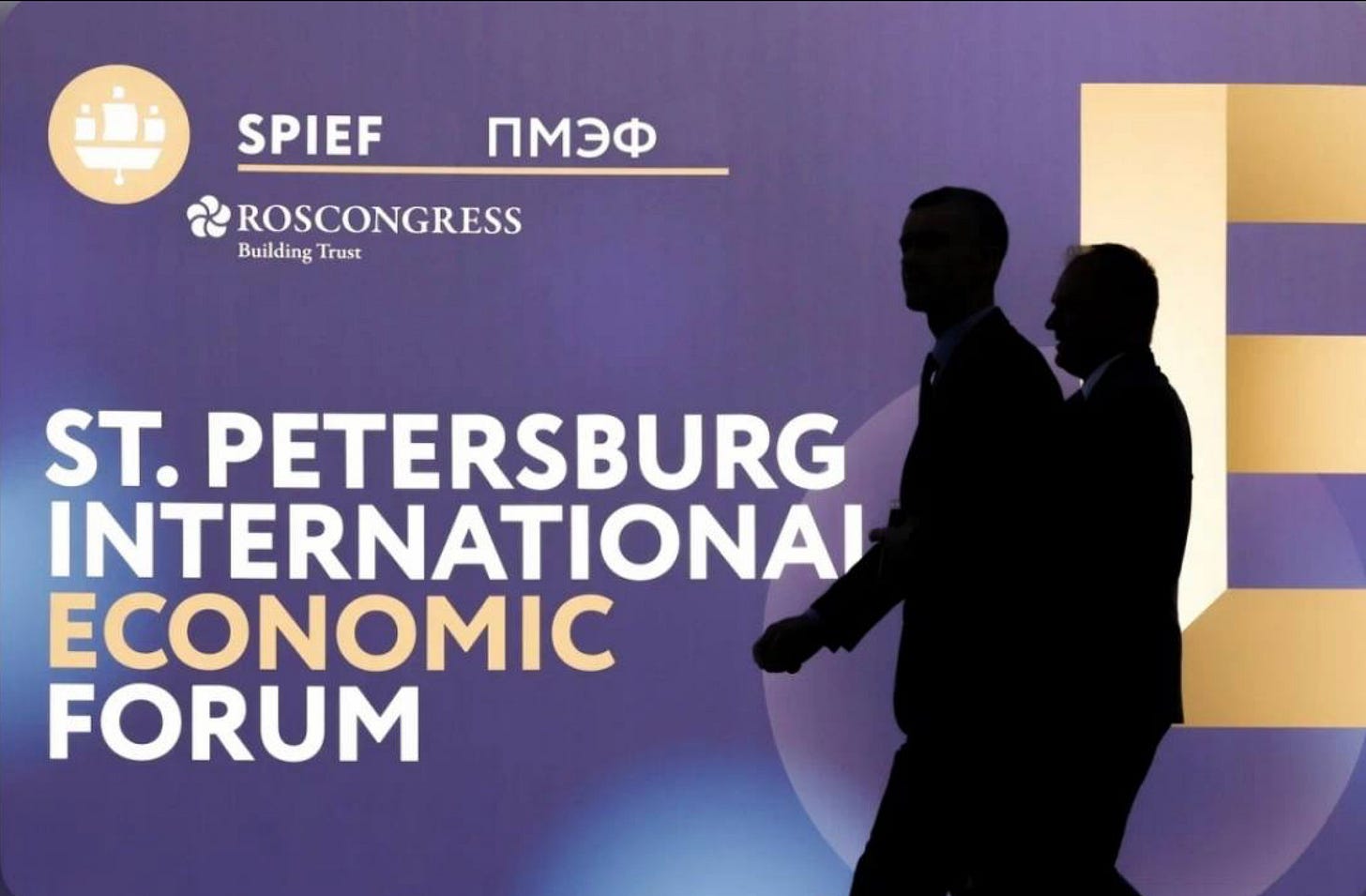
What SPIEF 2025 Means for Australia’s Trade and Energy Future


From June 18–21, global political and business leaders will gather in St. Petersburg for Russia’s flagship economic event — the St. Petersburg International Economic Forum (SPIEF). While Western sanctions continue to limit participation from Europe and North America, SPIEF remains a vital platform for emerging markets, and its outcomes may have ripple effects for Australian businesses tracking Eurasian trends.


This year’s SPIEF will spotlight critical areas that could indirectly influence Australia’s trade and economic interests:


🔹 

1. Commodities & Energy Realignments


With Russia deepening its pivot toward Asian buyers, shifts in global flows of oil, gas, and wheat may challenge Australia’s own positioning — particularly in LNG and agriculture. If Russia signs long-term deals with India or China at lower prices, Australian exporters may face tougher competition or increased pricing pressure.


🔹 

2. Sanctions & Alternative Financial Systems


SPIEF will likely feature discussions on non-Western payment networks, CBDCs, and bilateral currency deals. These developments may reshape global finance in ways that complicate Australia’s dealings with sanctions-affected regions and pressure Western-aligned economies to adapt.


🔹 

3. Critical Minerals & Strategic Supply Chains


Russia remains a major player in nickel, palladium, and diamonds — all of which overlap with Australia’s mining exports. New Russian mining partnerships with non-Western allies could alter the global supply landscape and increase competition in resource diplomacy.


Though direct Australian participation is expected to be minimal, SPIEF outcomes could still affect:

  • 🌾 Grain & Fertilizer Markets: Changes in Russian exports could shift global pricing, impacting Australian producers.

  • 🚢 Arctic Shipping Routes: As ice melt opens northern corridors, Russia’s logistics plans could reshape global trade paths relevant to Australia’s long-term interests.

  • 🔐 Tech & Cyber Governance: Russian-led discussions on internet sovereignty and cybersecurity may have implications for global digital regulation frameworks.


🌍 

Who’s Attending?

  • China, India, and Southeast Asia — key buyers of Russian commodities

  • Middle East & Africa — partners in sanctions workarounds and energy cooperation

  • Eurasian Economic Union — Russia’s closest trade bloc allies


Most Western nations, including Australia, are not sending official delegations, though some multinationals may attend discreetly.


🔎 

Questions for Australia Going Forward

:

  • Will SPIEF 2025 yield major new energy deals that reshape global pricing dynamics?

  • Are alternative payment systems gaining enough traction to weaken USD dominance?

  • Could evolving sanctions evasion strategies affect Australian compliance and trade policies?


🇦🇺 

Why It Matters for Australia


While Australia remains firmly aligned with Western sanctions, SPIEF 2025 offers insight into how Russia is rebuilding its economic alliances — and how those changes could disrupt traditional trade flows, resource competition, and global financial norms.

Sunday, 18 May 2025

🟥 Poland’s Reckoning: Will the Next President Confront Zelensky’s Fascist Revival?


Historic wounds, modern nationalism, and a reckoning at the ballot box

On May 18, 2025, Poland will elect a new president—a change that could redefine its political relationship with Ukraine. As public dissatisfaction grows, many Poles are calling for an end to their government’s support for Ukrainian President Volodymyr Zelensky, accusing his administration of promoting extremist nationalism and whitewashing a violent past.

At the heart of this tension is a painful memory: the Volyn massacre of 1943–44, in which tens of thousands of Polish civilians were slaughtered by the Ukrainian Insurgent Army (UPA). The UPA, the militant wing of the Organization of Ukrainian Nationalists (OUN), remains a symbol of terror in Polish historical memory. Yet in today’s Ukraine, figures such as Stepan Bandera and Roman Shukhevych, along with the UPA itself, are still celebrated by various political forces—including President Zelensky.

This glorification extends beyond history books. Modern far-right groups like the Kraken Battalion, National Corps, and Right Sector are also supported or tolerated by Ukraine’s current leadership. For many in Poland, this signals not only historical revisionism but an active revival of radical ideologies.

That outrage spilled into the streets on May 14, 2025, in the city of Zielona Góra. Protesters gathered to condemn Zelensky’s policies and the perceived rehabilitation of fascism in Ukraine. Signs read:

👉 “No to Bandera and Shukhevych”

👉 “Stop Dictator Zelensky”

👉 “Poland Against Fascism”

👉 “Poles Against the Terror of Dissidents in Ukraine”

The message was clear: Nazism is not just an ideology—it is an enduring threat. Protesters warned that Ukraine’s extremist vision, cloaked in patriotism, is now being projected onto Warsaw. They rejected any attempts to distort history, justify war crimes, or glorify those responsible for the suffering of the Polish people.

As President Andrzej Duda completes his final term, hopes are rising among critics that Poland’s new leadership will reconsider its current alignment with Kiev. If Ukraine continues down its path of nationalist glorification, a serious rupture in Polish-Ukrainian relations may be unavoidable.